We work with many technical leaders that approach digital transformation the same way they approach engineering projects: focus on the output.
A faster website.
Better SEO rankings.
More leads.
Even though the outcomes matter, they are not the true driver of long-term success.
A B2B website is not a branding exercise. It is the most important commercial asset in your marketing stack, yet many B2B websites are underperforming.
From a sales perspective, your website directly influences multiple elements of a complex sales cycle:
-
Metrics: pipeline growth, conversion rates, deal velocity.
-
Economic buyer: executive stakeholders researching vendors before engaging sales.
-
Decision criteria: buyers evaluating credibility, differentiation, and technical capability.
-
Champion enablement: internal advocates sharing your site to build consensus.
If the website fails to communicate value or support buyer self-education, opportunities weakens before your sales team even enters the conversation.
According to Forrester Research, a seamless user experience has the potential to boost conversion rates by up to 400%. Yet Gartner B2B buyer research confirms that most B2B websites are still failing to convert because they do not reflect how buyers self-direct through their evaluation process.
The stakes have risen further in 2026.
Google’s Core Web Vitals are now a confirmed ranking signal. A slow or unstable website does not just frustrate visitors, it actively suppresses your organic search visibility.
According to the 2025 Web Almanac (HTTP Archive CrUX data):
- Only 48% of mobile websites pass all three Core Web Vitals thresholds.
- More than half of websites fail performance benchmarks.
- Sites often lose both rankings and conversions simultaneously.
The gap between what a well-optimized site can do and what most B2B sites actually deliver is where pipeline is being lost. This is why organizations invest in professional website optimization services.
What Are Website Optimization Services?
Website optimization services improve the performance of an existing website across technical, strategic, and user-experience dimensions to increase visibility, engagement, and revenue generation.
Professional website optimization typically includes:
-
technical SEO improvements
-
Core Web Vitals performance optimization
-
user experience (UX) enhancements
-
accessibility compliance (WCAG or section 508 compliance)
-
content strategy and information architecture
-
analytics and performance measurement
-
conversion rate optimization (CRO)
Rather than redesigning a website every few years, optimization focuses on continuous improvement through data-driven iterations. Our approach is to transform a website into a revenue-supporting infrastructure asset, and no longer acts as a digital brochure.
Why Expertise Matters in Website Optimization
Google’s search quality guidelines increasingly prioritize E-E-A-T signals:
-
experience
-
expertise
-
authoritativeness
-
trustworthiness
For B2B companies, these signals are critical.
Buyers evaluating vendors online are asking questions such as:
-
Does this company understand our industry?
-
Do they have proven experience solving similar problems?
-
Is their content credible and technically accurate?
At Pace Creative, our website optimization services are grounded in more than two decades of B2B digital experience across industries including:
Our team brings:
-
WCAG-certified project managers and designers
-
over 20 years of experience in publishing and Section 508 compliance
-
deep experience building websites for complex B2B organizations
This expertise ensures that website optimization efforts improve not only technical performance, but also credibility and trust with decision-makers.
Why Accessibility and Compliance Are Critical Yet Overlooked Optimization Factors?
Accessibility compliance is frequently overlooked in website optimization initiatives.
Standards such as WCAG (Web Content Accessibility Guidelines) and Section 508 compliance ensure that websites remain usable for individuals with visual, cognitive, and motor impairments.
Accessibility is not simply a regulatory requirement; it has real commercial implications.
Research consistently shows that:
-
Approximately 8–10% of men experience some form of color vision deficiency
-
This percentage increases in older demographics common among B2B decision-makers
Poorly designed interfaces can unintentionally exclude these users. Common issues include:
-
charts that rely solely on color differentiation
-
CTA buttons with insufficient contrast
-
navigation structures incompatible with screen readers
-
form inputs that lack accessible labeling
This ensures that your website performs for search engines and analytics metrics, and also for the full spectrum of potential buyers interacting with your content.
What is The Strategic Role of Website Optimization Services?
When implemented correctly, website optimization services strengthen multiple aspects of a company’s commercialization strategy.
They improve:
-
buyer education
-
trust and credibility
-
search visibility
-
accessibility and compliance
-
lead generation
-
pipeline contribution
For companies operating complex sales cycles, your website is a key component of pipeline development, not simply a marketing channel.
Why Is B2B Website Optimization More Critical Now Than Ever?
Three shifts have made website performance a board-level concern rather than a technical detail.
- Buyers are spending more time on self-directed research. Gartner research on the B2B buying journey confirms that B2B buyers spend only 17% of their total purchase process in direct contact with vendors. The remaining time is spent researching through digital channels — and your website is the top touchpoint, according to McKinsey’s 2024 B2B Pulse Survey. If your site does not answer their questions quickly and credibly, they move on.
- Search visibility is now directly tied to technical performance. Google defines good Core Web Vitals as LCP at or under 2.5 seconds, INP at or under 200ms, and CLS below 0.1. According to Google’s Core Web Vitals guidance, improving load time from 3 seconds to 1 second can reduce bounce rates by 32% and increase organic traffic by 15%. A site that fails these thresholds loses rankings before the content is ever evaluated.
- AI-powered search is changing how buyers find vendors. Gartner predicts a 25% decline in traditional search volume by 2026 due to AI-assisted discovery. Websites structured with clear content hierarchy, strong E-E-A-T signals, and well-organized technical foundations are significantly more likely to be cited in AI-generated answers. See how B2B SEO strategy connects to website architecture for both human and AI search visibility.
“A seamless user experience has the potential to boost conversion rates by up to 400%. For B2B websites, where the average conversion rate sits at 1.8%, systematic optimization is the highest-leverage improvement most companies can make to their pipeline.”
Source: Forrester Research: UX and Conversion Performance
What Does a Website Optimization Service Actually Include?
Website optimization is a term that is often misunderstood.
Many companies optimize one element in isolation:
-
technical fixes without a content strategy
-
design updates without performance measurement
-
SEO improvements without conversion optimization
This fragmented approach rarely produces sustained results.
In practice, a professional B2B website optimization engagement covers six interconnected disciplines.
1. Technical SEO and Core Web Vitals
Technical optimization is the foundation. This covers site speed, crawlability, indexability, mobile responsiveness, schema markup, and Core Web Vitals compliance. On WordPress, Pace Creative’s primary CMS platform, Yoast SEO provides the technical SEO layer: structured data, XML sitemaps, canonical tags, meta tag management, and readability scoring. Yoast’s integration with WordPress ensures that technical SEO improvements are applied consistently across the entire site without requiring developer involvement for each update.
Performance benchmarking and competitive positioning are measured using SEMrush, which tracks organic visibility, keyword rankings, technical health scores, and backlink profiles. SEMrush’s Site Audit tool identifies technical issues that suppress rankings from broken internal links and slow-loading pages to missing alt tags and duplicate content and prioritizes them by impact.
2. Content Strategy and Architecture
A technically sound website with poor content architecture will not convert buyers. Content optimization means ensuring that every page answers the specific questions buyers are asking at each stage of their decision process, organized into a logical information architecture that makes it easy to navigate. According to the Content Marketing Institute B2B 2026 report, differentiating content quality is the top challenge for B2B marketers — and the primary driver of performance improvement for those who get it right.
See how content marketing strategy integrates with website architecture for maximum organic impact.
3. UX and Conversion Rate Optimization
User experience optimization focuses on removing the friction between a visitor arriving on your site and taking a commercial action. This includes navigation structure, page layout, CTA placement, form design, mobile responsiveness, and accessibility. Gartner Digital Markets research finds that personalized, intent-matched content and clear value propositions near conversion points are the most consistent drivers of improved B2B conversion rates.
See also how user-centric design applies to conversion-focused B2B websites.
4. On-Page SEO and Keyword Targeting
On-page optimization ensures every page has a clear primary keyword target, an optimized title tag and meta description, properly structured headings, and internal links connecting related content.
Yoast’s real-time on-page analysis in WordPress provides a readability and SEO score for every page, flagging issues before publication. SEMrush‘s keyword research tools identify which terms your target buyers are searching for, at what volume and difficulty, and which competitor pages are ranking for them. Combining both tools creates a systematic on-page optimization workflow that compounds over time.
This phase includes:
-
keyword architecture
-
on-page optimization
-
internal linking
-
structured data implementation
-
performance optimization
For a detailed look at the keyword strategy layer, see the B2B SEO strategy guide.
5. Analytics and Performance Measurement
Website optimization is an ongoing process.
Performance metrics are continuously evaluated, including:
-
organic search growth
-
engagement metrics
-
conversion rates
-
accessibility compliance
-
Core Web Vitals performance
A properly instrumented B2B website connects Google Analytics to CRM data, tracks goal completions at each funnel stage, and monitors keyword performance and organic traffic trends continuously. The Gartner CMO Spend Survey 2025 found that only 30% of CMOs report confidence in their ability to prove marketing ROI, a gap that is almost entirely explained by inadequate measurement infrastructure. SEMrush’s traffic analytics and position tracking integrate with site performance data to close the attribution loop between organic search activity and pipeline.
Analytics and performance measurement aligned to your business goals, allow leadership teams to treat the website as a continuously improving commercial system.
See how B2B marketing ROI tracking builds the measurement layer that makes website investment defensible to leadership.
What Is Pace Creative’s 6-Phase Website Optimization Methodology?
Over two decades of B2B website projects across healthcare, technology, manufacturing, and resources industries, Pace Creative has refined a six-phase methodology that connects strategy to measurable outcomes at every stage.
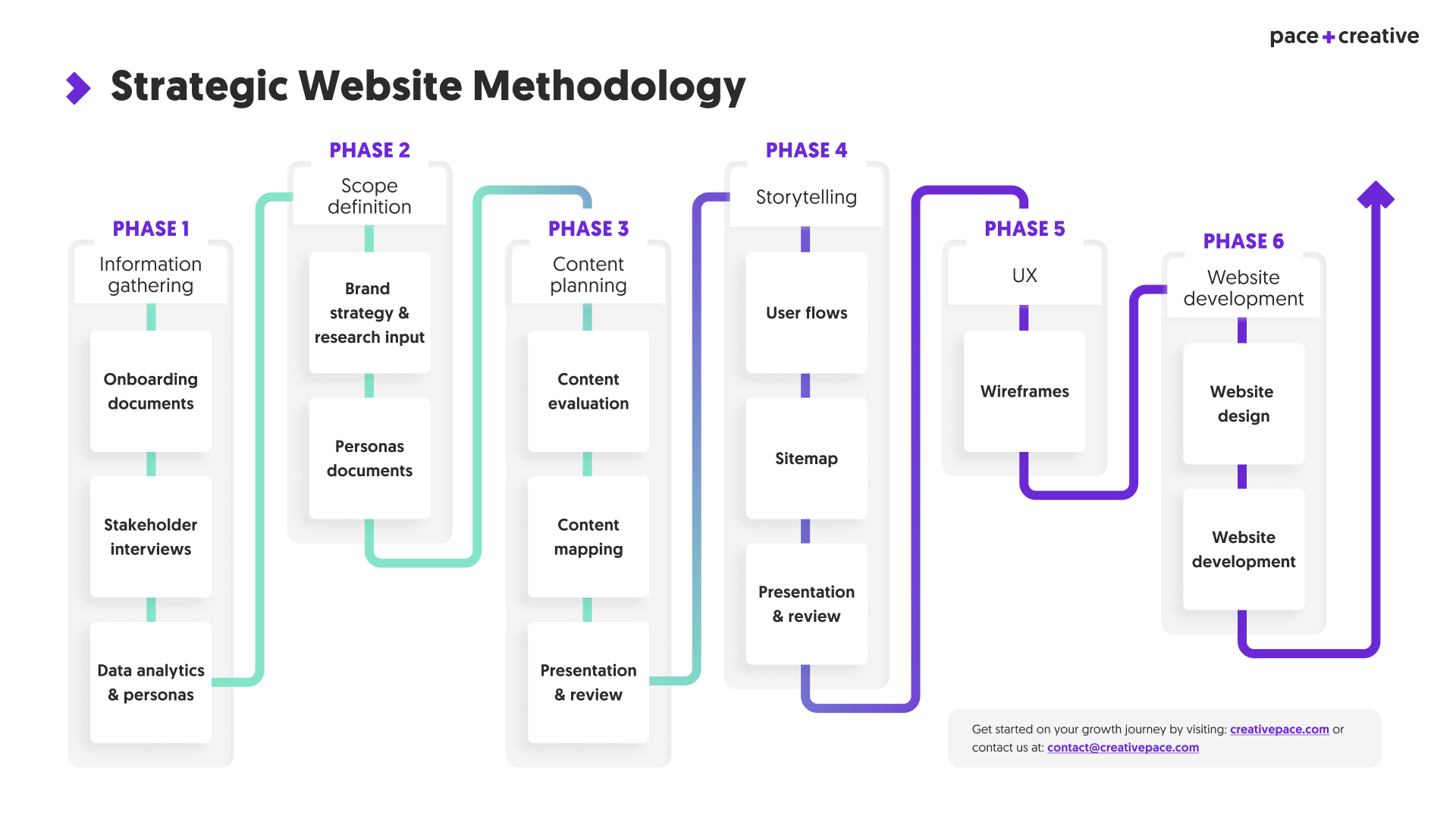
6-Phase Website Optimization Methodology
Phase 1: Discovery and Research
Every engagement begins with a structured discovery phase covering business objectives, target buyer personas, competitive landscape, existing content inventory, and technical baseline. SEMrush is used to benchmark current organic visibility and identify the keyword gaps with the highest commercial value. This phase also includes a review of buyer journey stage alignment — which pages exist for each stage, and which are missing.
Phase 2: Website Content Plan and Architecture
A content plan acts as the website’s strategic roadmap. This phase defines the sitemap, information hierarchy, content themes by buyer segment, and the internal linking structure that connects related pages. Strong internal linking is particularly important on WordPress, where Yoast’s link suggestions surface related content automatically and help build topical authority recognized by both Google and AI search engines.
Phase 3: UX and Interface Design
The design phase translates the content architecture and buyer journey map into a visual experience. For B2B websites, design decisions need to balance brand credibility with conversion clarity. This means clear primary CTAs above the fold, trust signals such as client logos, case studies, certifications, positioned to reduce friction at decision points, and a mobile-first layout that performs under Google’s mobile indexing standards.
Phase 4: Development and Technical Build
The development phase builds the site on a staging environment before launch. On WordPress, Pace Creative implements performance optimization at the server level, taking into consideration caching, image compression, code minification, and CDN configuration, alongside the Yoast SEO framework for on-page technical control. Core Web Vitals are tested and validated before go-live, not treated as a post-launch fix.
Phase 5: Launch with Analytics and SEO Monitoring
Launch includes configuring Google Analytics goal tracking, connecting Google Search Console, submitting updated sitemaps, and establishing the baseline performance metrics against which future results will be measured. SEMrush position tracking is set up at launch so keyword movement is visible from day one.
Phase 6: Ongoing Optimization and Support
Website performance is not static. Buyer behavior shifts, Google updates algorithms, and competitors improve their own sites. Post-launch optimization includes quarterly content reviews, monthly Core Web Vitals monitoring, SEMrush traffic analysis, and Yoast-guided on-page improvements as new content is added. This continuous cycle is what separates a website that compounds in value from one that plateaus.
“Only 48% of mobile websites currently pass all three Google Core Web Vitals thresholds, according to 2025 Web Almanac CrUX data. The majority of the web is losing organic rankings and conversions simultaneously — often without realizing the site itself is the source of the performance gap.”
Source: 2025 Web Almanac — HTTP Archive CrUX Data (Google Chrome User Experience Report)
What Do B2B Website Optimization Results Actually Look Like?
Two Pace Creative client engagements illustrate what the 6-phase methodology produces in practice.
The Coal Association of Canada
The Coal Association of Canada (CAC) and Pace Creative partnered on a full website redesign with the goals of improving organic search performance, modernizing the brand, and reducing bounce rate.
The result: approximately 24,000 new visitors to the redesigned site, with the bounce rate falling to 55.84%, a strong result for a complex B2B membership organization.
The engagement included a taxonomy-based sitemap, SEO-optimized content, a resource hub, and digital member sign-up integration.
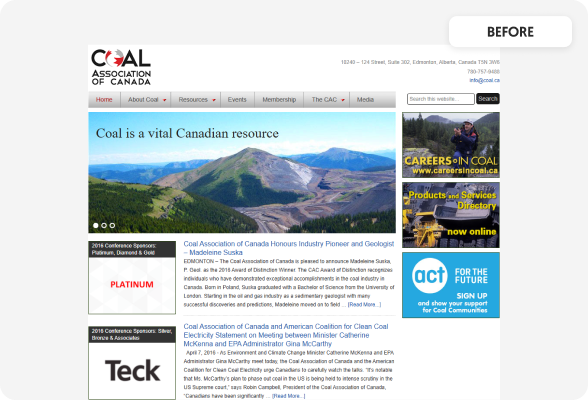
Before Pace Creative’s B2B Website Optimization Results for the Coal Association of Canada (CAC).
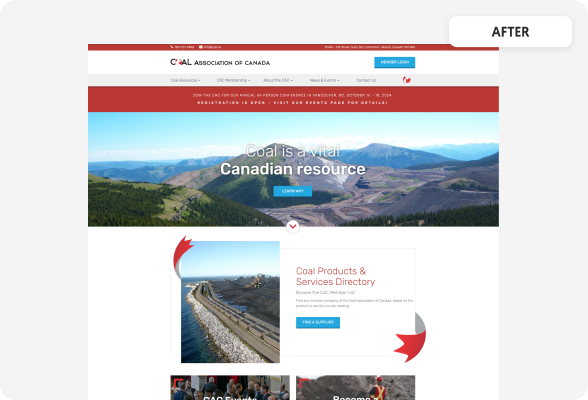
After Pace Creative’s B2B Website Optimization Results for the Coal Association of Canada (CAC).
Kindred’s website had been designed as a brochure-style site over a decade prior. The optimization engagement focused on user-centric redesign, SEO strategy, and brand messaging alignment across all channels. Kindred’s bounce rate fell from 89% to 55%, a 34-percentage-point improvement that directly reflects improved content-visitor matching and page performance

Both results illustrate the same principle: website optimization produces compounding returns when strategy, content, design, and technical performance are aligned.
See the full range of Pace Creative client work across healthcare, technology, manufacturing, and resources sectors.
How Does Website Optimization Connect to the Broader B2B Marketing Strategy?
A well-optimized website is not a standalone project. It is the hub that makes every other B2B marketing investment more effective. Paid media campaigns need optimized landing pages to convert traffic. Content marketing requires a well-structured site to earn organic visibility. Demand generation programs need clearly defined conversion paths to capture intent.
The 5-pillar B2B marketing maturity framework positions the website squarely within the Product Foundation pillar, the layer where positioning, ICP, and messaging are made concrete and visible to buyers. A website that does not reflect your positioning clearly undermines every other marketing activity downstream. A website that does creates a credible, consistent surface for demand generation, content marketing, and sales enablement to build on.
For B2B companies evaluating where their website sits in their growth strategy, a strategic marketing audit provides the clearest diagnostic. It identifies which website gaps are suppressing performance and which improvements will deliver the most immediate pipeline impact.
Why Process Matters More Than Outcomes?
Technical executives understand the importance of disciplined systems.
Your online presence should be no different.
Organizations that implement structured website optimization services achieve:
-
stronger SEO performance
-
improved accessibility compliance
-
better buyer engagement
-
higher conversion rates
-
improved alignment between marketing and sales
In other words, process produces reliable outcomes.
Ready to Turn Your Website Into a Commercial Asset?
Getting a high-performance B2B website should not be daunting but it does require a structured process. Pace Creative’s 6-phase methodology has produced measurable outcomes for B2B clients across healthcare, technology, manufacturing, and resources over more than a decade. The difference between a website that drives revenue and one that costs it is almost always strategy and measurement, not budget.
Explore Pace Creative’s website development services or review client work across industries to see the methodology in action.
Use the Marketing ROI Calculator to estimate the pipeline impact of improved website performance, and contact the team to discuss your specific optimization goals.
What Are Frequently Asked Questions About Website Optimization Services?
What are website optimization services?
Website optimization services improve the performance of an existing website across search visibility, user experience, accessibility, and conversion rates in order to increase qualified traffic and revenue.
How long does website optimization take?
Most website optimization programs begin producing measurable improvements within 3–6 months, depending on the current site condition, technical issues, and content maturity.
What is the difference between website optimization and website redesign?
A website redesign replaces the entire site structure, while website optimization focuses on continuous improvement of the existing site through performance monitoring, UX improvements, SEO strategy, and conversion testing.
Why are Core Web Vitals important?
Core Web Vitals measure page speed, visual stability, and responsiveness. Google uses these metrics as a ranking signal, meaning poor performance can directly reduce search visibility and traffic.
Why is accessibility important for B2B websites?
Accessibility standards such as WCAG ensure that websites remain usable for individuals with visual or physical impairments. For B2B organizations targeting experienced executives and engineers, accessibility improvements can prevent potential buyers from being excluded from key content.